TireTracker
Service recordkeeping for commercial tire shops, and the fleet portal that reads it.
- Studio product
- Studio product
- Google speed
- 99 mobile · 99 desktop
- Live site
- tiretracker.app
What the business does
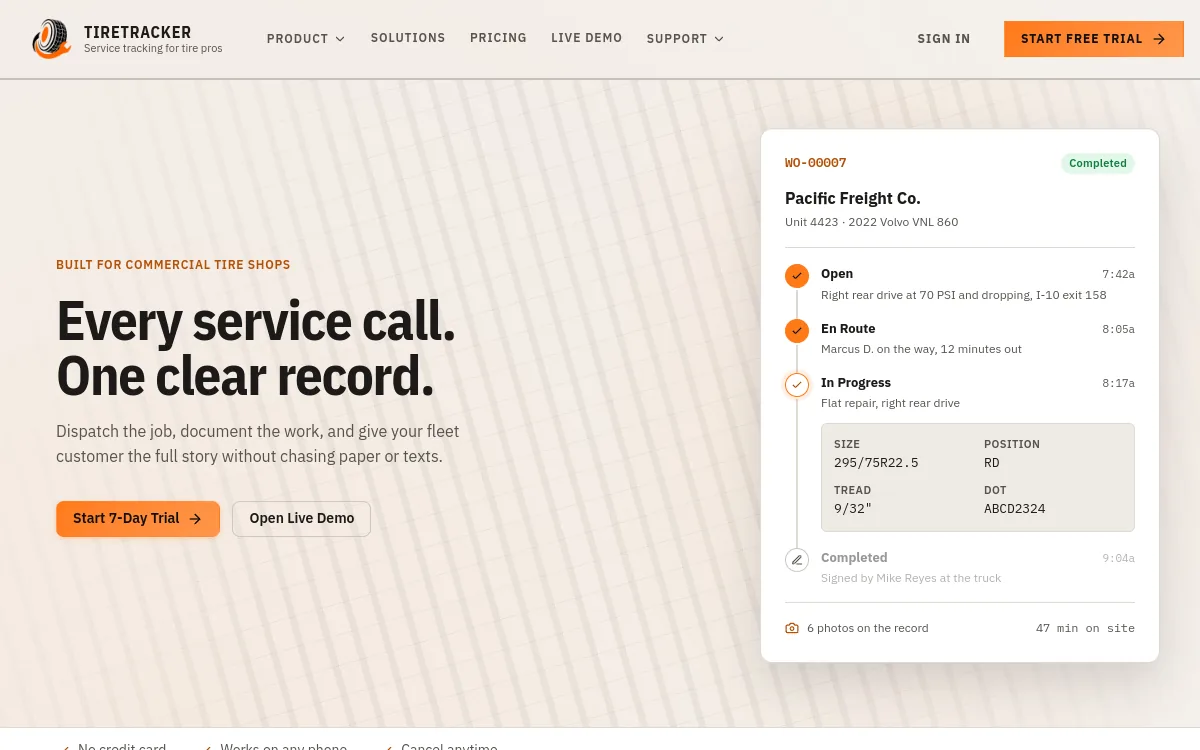
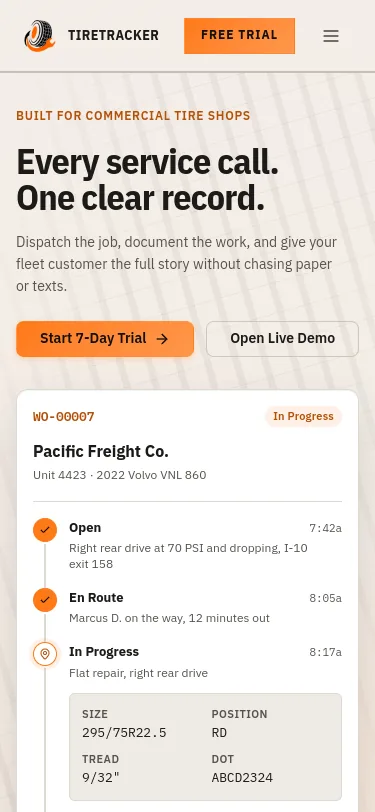
TireTracker is a TaylorURL product rather than a client site. A shop logs what its technicians did to which tires on which trucks, and its fleet customers see that history in a portal of their own.
It is a recordkeeping product rather than a billing one. What it captures is the work: tire positions, DOT codes, tread depths, photos, and signatures, so a shop and its customers stop disagreeing about what was done.
What a visitor can do here
Logged where the work happens
A technician records a job from the roadside, with the codes, the depths, the photographs, and the signature attached to it at the time.
The fleet reads its own history
The customer signs in and reads their own service history rather than asking for it.
One subscription, and no more money moving
The shop’s own subscription is the only payment the product handles.
How it is put together
Tenant isolation, enforced twice
Every query is scoped to a shop in application code, and Postgres row-level security backs it up. Routes are assembled from wrappers that set the security context, so a route written by hand reads and writes nothing.
Deletes are soft
Records, photos, vehicles, and clients carry a deletion timestamp, reads filter them out, and a scheduled job removes for good what has been gone thirty days.
Photos out of the database
Uploads go to object storage through a queue, so a technician on a weak signal is not holding a job open waiting on an image.
Built with Next.js 16, Clerk, Prisma, Neon Postgres, Tailwind CSS 4, Stripe, Cloudflare R2, Sentry, Vercel.
How fast it loads
tiretracker.app scores 99 on mobile and 99 on desktop in Google PageSpeed Insights, out of 100, measured on November 10, 2026. A single Lighthouse run moves by several points between calls, so each figure is the median of 3 runs.
